

I. Two profiles of the same system

In the last few weeks, England has been held up to America as both an educational success story and a warning. Both accounts have value and that is precisely why the comparison is interesting.
The first is the England of the PISA 2025 results and Robert Pondiscio and Nick Gibb’s positive reading of them in National Review. England’s fifteen-year-olds now rank eighth in science, ninth in reading and tenth in mathematics, maintaining their position at a time when performance declined across much of the developed world. Younger children have also moved up in PIRLS, from tenth place in 2011 to fourth in 2021. The proportion of six-year-olds meeting the expected standard in the phonics screening check rose from 58 % in 2012 to 82 % in 2018. In PISA 2025, the reading gap between England’s most and least advantaged pupils narrowed by 16 points from 2022 and is now smaller than the OECD average.
There is plenty here to take seriously. Pondiscio and Gibb offer a generous account of what England’s reforms have achieved, and their argument is likely to become part of a wider conversation about what American education might borrow from England.
Then there is another England.
Writing in the London Review of Books in August, William Davies describes a generation in which more than a million people aged 16 to 24 are not in employment, education or training. Anxiety and withdrawal from school have risen sharply. Youth disability has doubled since 2016. Davies reports that Britain has the highest rates of anxiety and depressive disorders among 15- to 24-year-olds in the OECD. In the PISA 2022 questionnaire, 63 % of pupils in England said that they felt they belonged at school, compared with an OECD average of 75 %; Davies notes that the decline in England on this measure between 2003 and 2022 was the sharpest in the OECD. Alan Milburn’s interim review describes what is happening at the transition into adulthood as a “structural breakdown.”
These accounts are not necessarily contradictory as they are describing different things, but that difference is important to unpick.
It is tempting to turn them into an argument about which England is the real England.
Is this evidence of a coherent and efficient education system doing something right, or of a system that is becoming increasingly successful at producing outcomes while making the experience of education less meaningful?
Is coherence itself part of the problem? Have we become so focused on what can be specified, measured and improved that we have lost sight of what education is for?
The answer depends, in part, on what we think we are trying to optimise.
That sounds like a familiar policy question. But I think there is a deeper issue underneath it.
Headlines of this kind invite a divisive argument about which account is right, what should be accepted as evidence, and whether a system should be judged by its measured performance or by how it is experienced. The instinct is to choose one and demote the other to a caveat.
But these accounts do not enter the conversation on equal terms.
One arrives in the idiom the system has been built to hear: scores, ranks, cohorts and gaps, collected regularly, audited, compared and attached to consequences. The other arrives as testimony, as survey responses for which nobody is accountable, as qualitative accounts, as essays like this one. Before it can make an argument, it has to establish why its subject matter should count as evidence at all.
This is particularly clear in the way we talk about belonging. Those of us who want to defend belonging as an important part of educational life often find ourselves saying that belonging matters because pupils who feel that they belong tend to perform better academically. The claim may be true but notice that we’ve had to translate the experience of belonging into the language of attainment before it is granted full legitimacy.
The texture of a child’s school life becomes admissible because it can be shown to pay a levy in attainment points. Whatever cannot pay that levy risks being dismissed as sentiment.
That is one version of the contemporary division between facts and values. But I think something more interesting is happening. The difficulty is not simply that one side has numbers and the other has feelings. It is that our instruments have been designed around a constrained account of what we assume we need to know.
I situate my perspective as an insider researcher with a unique vantage point of a Bulgarian-American education scholar who spent more than a decade in the weeds of UK public policy, including England’s schools’ inspectorate - Ofsted. I have helped build the kind of coherent accountability architecture this essay examines. Coherence has real virtues - clear expectations, a shared curriculum, common standards and aligned assessment can make a fragmented system more intelligible and, sometimes, more equitable. But I have also seen what happens when the instruments we build to make a system coherent become the way we understand the system itself.

We design tools to see particular things. Then we become very good at seeing them. Once they are visible, they can be measured, compared, managed and improved. What the instrument cannot register becomes harder to talk about, and eventually easier to regard as peripheral. This matters because education contains things that do not arrive neatly as variables.
A child can know the answer to a question without yet knowing what the answer means. A pupil can attend school without feeling that they have any reason to be there. A young person can acquire qualifications without being able to imagine a future in which those qualifications have a place. A classroom can be orderly while the students inside it have become detached from what they are being asked to do.
These are not arguments against knowledge, standards, assessment or discipline. They are questions about what those things are for. England’s reforms have been powerful partly because they embody a particular view of knowledge and learning – where knowledge can be specified, sequenced, taught, acquired and progress can be explicitly assessed. That view has made it possible to build a remarkably coherent system around a common curriculum and common expectations.
But coherence always has a price. Once a particular account of learning is embedded in curriculum, assessment, teacher training, inspection and accountability, it becomes easier to see what conforms to that account and harder to see what falls outside it.
The issue, then, is not simply whether England’s reforms work. Some clearly do, in the terms for which they were designed. The more interesting question is what those reforms have made visible, and what they have left difficult to see.
That is also where the comparison with America becomes more useful. The lesson is unlikely to be that America should simply import England’s curriculum, assessment practices or accountability structures. Policies travel with the assumptions that produced them. A system can borrow an instrument without borrowing the context in which it made sense, and it can become even more instrumental in the process.
My concern is therefore less with whether America should become more like England than with what it might learn from the way England has built coherence—and what it might fail to notice if it adopts that coherence without examining the socio-political assumptions and account of knowledge underneath it. Once we have built a system to see certain things, it becomes remarkably easy to mistake what the system can see for what is there.
That is the problem I want to explore, so please bear with me.
II. The value and promise of coherence
Let me start with the selling points that Pondiscio and Gibb shed light on.

England did not simply write a set of ideas into a curriculum - it tightened its hold on the whole system and pulled every lever in the same direction: curriculum documents, statutory assessments, teacher training, inspection and school accountability, all organised around one account of what children should know and how they come to know it. And then, unusually for education policy, it held its nerve for more than a decade. A test on its own changes very little. A curriculum on its own reaches only the classrooms that choose to take it seriously. However, a standard that is assessed, published, inspected and taught to every new teacher reaches almost all of them.
David Steiner has argued for years that American schooling struggles because its standards, curricula, assessments and teacher preparation pull in different directions. England is what it looks like when they pull in the same direction at once – and it’s a strong hold. Pondiscio and Gibb hold it up as an approximate ideal for American states that should: decide what children should know, adopt high-quality materials, prepare teachers to use them, all “while ensuring that assessment and accountability reinforce rather than undermine those choices.”
The phonics screening check belongs in this picture. It was the outcome measure by which the whole infrastructure was judged, and on its own terms it has done well. But the headline figures deserve a slower reading. England’s PISA reading score was 505 in 2018, 496 in 2022 and 497 in 2025, and the climb in rank owes a good deal to other countries falling faster. When the results were published, the Department for Education said as much itself: England’s reading and maths scores in PISA “haven’t improved in ten years.” The phonics check has sat at 80 % for three years running, just below its peak, and in 2025 two thirds of disadvantaged pupils met the standard against 84 % of their peers. And because England’s own assessments and PISA reward much the same curricular emphases, a rise in one can be understood as a confirmation of the other.
So what has England achieved? I would call it sufficiency. More children now clear the threshold, and fewer are left beneath it. Anyone who has watched a nine-year-old struggle to read a sentence knows how much that matters, especially for our American context. But sufficiency and proficiency are different things, and proficiency is not simply the far end of the same scale. A child who decodes fluently and answers comprehension questions correctly may or may not be able to follow a contested argument, or notice what a text quietly commits its author to.
There is some cynicism in the debate about proficiency vs growth. One could say that growth is just a polite word for staying behind. When a system’s instruments can register movement along a scale but cannot register the quality of understanding and normative engagement reached, growth becomes the working ambition for most children and proficiency remains the expectation for a few.
The practices now spreading under the banner of cognitive science, such as retrieval, recall and modelling, are useful. They are also, by design, about how efficiently content is acquired and kept. Extension is a different experience altogether – the text that will not resolve into a comprehension answer, the argument that has to be worked through, the judgement that nobody can model for you in advance.
England, in other words, shows us what happens when a system becomes very good at pursuing one particular conception of education (that remains silently unsettled). Whether that conception is enough is another matter, and to answer it we have to look at the conception itself.
III. What the instruments assume
Every measure begins with a decision about what schooling is and what education is for. By the time the numbers arrive, that decision has usually been forgotten.
inferen

The decision behind England’s architecture is a particular picture of knowledge. Philosophers call it representationalist, and most policymakers assume it without ever needing to interrogate it. Knowledge is content held in the mind. Learning is the efficient transfer of that content into memory. The learner is an individual processor with limited capacity, which is why so much now depends on managing cognitive load. Cognitive load theory has earned its authority in curriculum policy, and I have no wish to dismiss it. Its usual rival, constructivism, turns out to share more with it than either side likes to admit: both assume that learning is, at bottom, something that happens inside an individual head.
The famous physicist, Richard Feynman had a lovely way of showing what this picture leaves out. You can know the name of a bird in every language in the world, he said, and still know absolutely nothing about the bird. The names are retained content, and they are perfectly testable. What they do not give you is any grasp of what the bird does, what follows from its being that kind of creature, or what question its behaviour might answer.
There is another way of thinking about knowledge, which I have tried to set out in “Beyond the Knowledge Wars” drawing on philosophy of language and mind. On the inferentialist accounts of Robert Brandom and Jan Derry - to know something is to occupy a position in what Wilfred Sellars calls the “logical space of reasons”: to be able to justify a claim, to see what follows from it and what it rules out, and to know under what conditions it holds. Meaning is sustained rather than stored, in a shared practice of giving and asking for reasons, where the learner is no longer a container of variable capacity, but someone who responds to reasons and can be held to them. The teacher believes in the human potential for being responsive to reasons and engages students in the richness of the subject domain rather than restrict to decontextualised items.
This changes what an instrument can see. The phonics screening check is a good test of decoding. By design, it tells us nothing about whether a child reads in the fuller sense: follows an argument, notices an implication, cares what a text says. Nothing in its 80 % is misleading but was simply never built to see more.
There is a second reason for caution, and I think it runs deeper. Since the Education Endowment Foundation was established in 2011, education research in England has increasingly taken the randomised controlled trial as its gold standard, and policy has leaned more and more on what trials can show. Theoretical work, meanwhile, has come to be treated as background, something to return to once the evidence is in. Trials have taught us a great deal but they borrow their authority from medicine, and medicine has something education lacks: a criterion that sits largely outside the measurement. For example, the drug effectiveness is either confirmed or not. In education, the thing being studied is partly made by our judgements about what matters. “Knowledge”, “effective teaching”, “progress”, “attainment” and now “engagement” are not things out in the world waiting to be measured more precisely; their relevance rests on prior, and contestable, views about what schooling is for and what human beings should do with that knowledge in their communities – or polis. That is why disputes about assessment are never purely technical, and why a policy architecture can be entirely coherent while still arguing, without admitting it, about what kind of person it means to form.
If we put the two points together - something uncomfortable follows… such that if knowing is largely the accumulation of content, -> then school is a delivery system and attendance a matter of dosage. A pupil who stays away has missed their exposure to instruction, and the remedy is to restore it through incentives, expectations and enforcement. Later, the same young person reappears in policy as a problem of supply. Davies notes that even the newest proposals, linking schools more closely with employers, slide back into “treating the Neet issue as a problem of labour supply, rather than a deeper crisis of wellbeing.” At school the young person is a recipient who failed to receive; afterwards, a unit of labour that failed to arrive. In neither picture do they have reasons.
This, I think, is the distinction that matters. The representationalist picture can explain withdrawal perfectly well in terms of causes: anxiety, poverty, phones, poor sleep, weak incentives. What it cannot do is treat withdrawal as something a young person does for reasons, which might be weighed, answered, and sometimes found to be good ones. If knowing is participation in the space of reasons, then a young person who stops attending is also taking a position within it. We may disagree with that position. But we can only respond to it once we recognise it as one.re
IV. The same picture, applied to conduct
The picture of the learner that shapes how we teach also shapes how we manage behaviour. This is where my own unease as an educator and a researcher began.

Over the past decade, I have visited a number of London secondary schools that present behaviour management as their principal achievement: the promise of silence and the certainty of detention. The corridors are quiet, the transitions orderly, the children apparently content. On the walls, quotations about silence from Rumi, Lao Tzu and Confucius make the moral claim explicit. No one could deny the efficiency of silent transition that mitigated any possibility of disruption.
A Year 7 girl once explained the rules to me. Five minutes to reach the next lesson, or a detention. A word spoken in the corridor, and a detention. Answer back, and a detention. I asked whether she was all right with that. She said, almost proudly, that she was. She was describing who she had become at that school.
Silent corridors have a history: military academies, strict boarding schools, the American “no-excuses” charter networks of the 1990s and 2000s, and in England Michaela Community School from 2014, with ministers endorsing the approach for public schools since. What strikes me is who the practice is for. It has spread furthest in schools serving the least advantaged children. It is rarely the culture of private schools in England that mostly educate the children of particular classes, where student voice, belonging and autonomy are contrastingly encouraged. Obedience and silence for some children, independence and voice for others. I find that hard to square with the claim that a ‘knowledge-rich education is a route to social mobility’.
What the system itself can see of this is remarkably little. The Education Policy Institute’s analysis of London secondary schools (2026), found that 96 % use internal exclusion and that around 1 in 5 pupil experiences it in a year, with rates ranging from under 2 % in one school to over half in another. A spread that wide says more about how schools define the practice than about how children behave. Pupils with special educational needs and those from more disadvantaged areas are roughly twice as likely to be removed. One study found that a quarter of referrals were for truancy. Consider what that means: a child who has stayed away from lessons is punished by being removed from lessons.
More than a fifth of the schools asked could not say how often they used internal exclusion at all, and there is no national count. A practice that touches perhaps a fifth of pupils each year is invisible in the architecture America is being invited to admire. It was never made into a measure, so it never became a fact.
Silence is never neutral. Amy Hanna, who studied it in an English secondary school, found that young people experienced it in contradictory ways, and one of her participants said that sometimes the quiet is violent. Enforced as a blanket rule, silence stops being a condition for concentration and becomes a statement about virtue: to be quiet is to be good, and to speak is to risk a sanction. It begins to shape how children understand belonging itself. The UN Convention on the Rights of the Child recognises every child’s right to express their views in matters that affect them. A school that systematically silences children teaches them about participation mainly by showing them its absence.
Here the argument about knowledge and the argument about behaviour meet. A behavioural technique works on conduct and leaves reasons untouched. It can secure compliance, and compliance can be counted, reported and inspected. What it cannot do is draw a young person into the practice of giving and asking for reasons, it cannot inform and challenge their reasons, and it cannot act on their reasons - which is where agency comes from. The same picture that treats knowledge as content to be transmitted treats behaviour as an output to be shaped, and in both the child appears as something to be processed. Tellingly, the EPI found lower rates of internal exclusion in schools that build in student voice and restorative approaches. The alternative to enforced silence was never chaos - it is a different idea of what order is for.
V. Absence as a reason
This is where I think the argument matters most, and it is the part of the English story American readers will recognise the most.

Attendance policy on both sides of the Atlantic has become impressively good at counting absence, spotting patterns and telling parents how many hours of learning their child has lost. All of it treats absence as a behaviour that needs to be corrected. Sometimes that is exactly what it is, as for many young people, absence says something about their relationship with school.
A pupil who stays away because school has become a place of anxiety, failure or not belonging is not making a poor calculation about lost instructional time. If we think of absence as lost time, our tools will be incentives, expectations and pressure on parents. If we think of it partly as a question of meaning, we have to look at the experience of school itself: whether a young person (and their family) see what they are being asked to learn as worth learning, and see themselves as someone who belongs to the practice of learning it. There are other socio-economic reasons that make these reasons a lot more complicated and worth engaging in.
The numbers suggest we should take a closer look. Severe absence in England, meaning pupils who miss at least half of all sessions, has almost tripled since before the pandemic, to roughly 176,000 children. More than one in six disadvantaged pupils in Years 8 to 10 was suspended or excluded at least once in 2024/25. The United States has its own version: chronic absenteeism rose from 15 % in 2019 to a peak of 28 % in 2022, and was still around 23 % in 2025.
Then there are the young people Davies writes about, the million outside work, education and training (NEET). The testimonies gathered for Alan Milburn’s review keep returning to school. People traced their withdrawal to a particular misdemeanour, a failure or a penalty received years earlier. One said that being sent home had felt “like winning the lottery.” When a sanction feels like release, it tells us what the institution had come to mean.
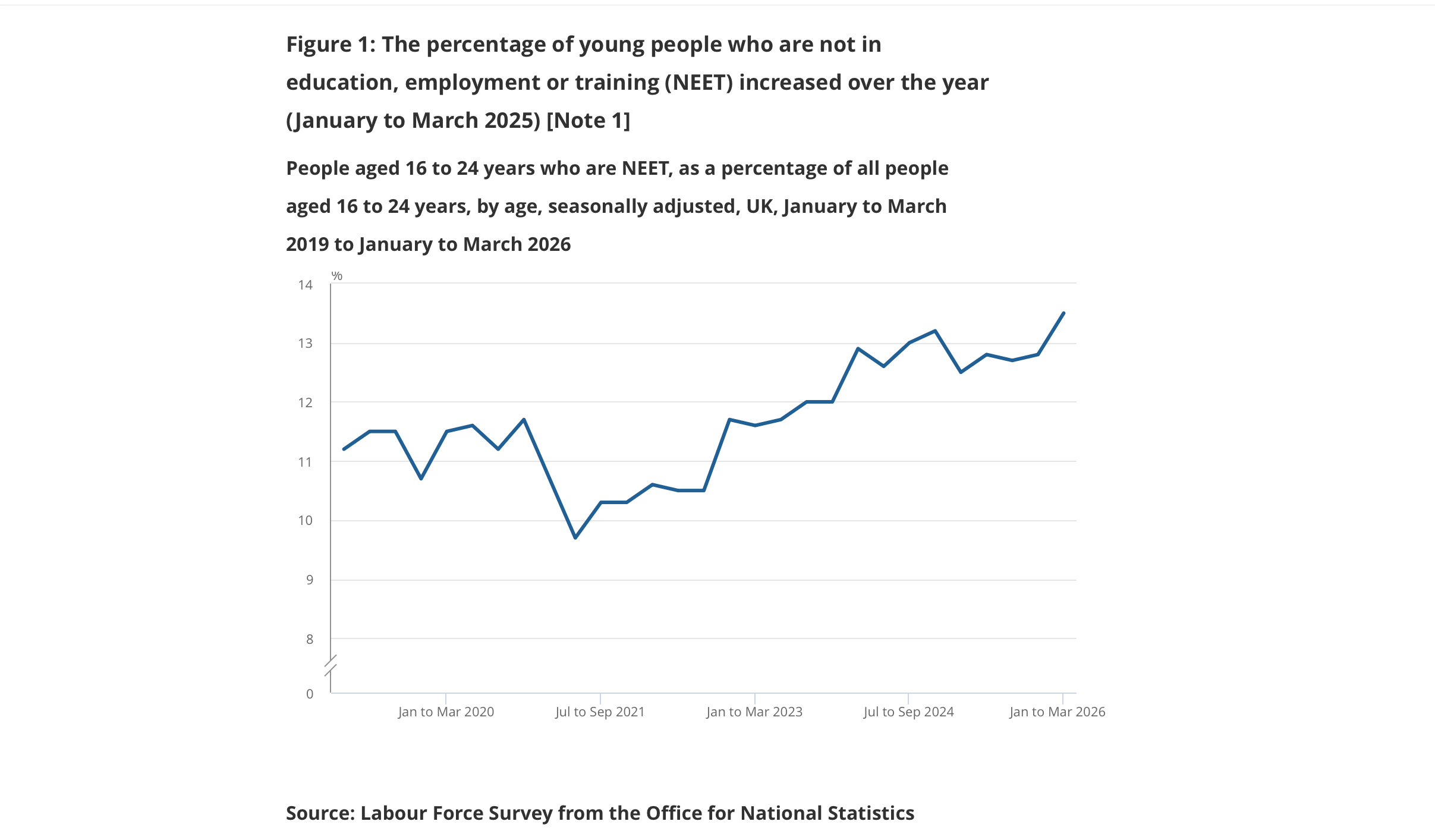
I do not want to overclaim, but as Davies carefully attends to - poverty, the pandemic, phones, poor sleep and the loss of youth services all play their part. But as long as we read absence only as a behavioural failure, we will keep reaching for behavioural remedies, and we may keep making the problem worse.
VI. What America should learn
So what should America take from England? Less a set of instruments, I think, than a way of looking at the architecture it is about to build. Borrowing the phonics screening check, an inspection framework or a behaviour policy means borrowing the visible surface of a settlement whose real substance lies in the questions England answered along the way, often without noticing it was answering them. And America is not starting from nowhere. More than half the states have passed laws on reading instruction since 2022, a federal science of reading bill passed the House last month, and states are reviewing and adopting curriculum materials at a pace not seen in decades. The question is no longer whether to build coherence, but what kind.
Read the science of reading whole. America’s reading movement already has the better definition. The bill that passed the House defines the science of reading to include phonemic awareness, phonics, vocabulary, fluency and comprehension, and “the importance of background knowledge, oral language, the connection between reading and writing.” The risk lies in what happens when a definition like that meets an accountability system. Decoding is easy to test in a five-minute check; background knowledge, talk and the habit of reading are not. England is the cautionary case. The share of six-year-olds passing the phonics check rose by more than twenty points in six years. Over a similar period, children’s enjoyment of reading fell to a twenty-year low: in 2025 only one in three young people aged 8 to 18 told the National Literacy Trust that they enjoyed reading, and fewer than one in five read anything daily in their free time. I would not blame phonics for that; screens, and much else, have played their part. But the measure the system watched most closely could not see it. Decoding taught inside rich books that are read aloud, talked about and returned to is a different practice from decoding drilled in isolation and certified by a check. States writing reading laws should make sure their instruments reward the first.
Give children a pedagogy of access, not only a vocabulary from cognitive science. American reformers have taken up the language of cognitive science quickly, and much of it is sound. But working memory and retrieval practice describe how memory works. They do not tell us what children should be brought into, or how. Michael Young’s idea of powerful knowledge, much invoked in England’s curriculum debates, was always about access: the specialised knowledge of the disciplines lets young people think beyond their immediate experience, and withholding it from poorer children is a form of injustice. Young also insisted that curriculum and pedagogy are distinct. A knowledge-rich curriculum specifies what is worth knowing; it takes a teacher to turn it into an invitation. A pedagogy of access treats a child as someone who can enter the argument a discipline is having (why the colonists called taxation without representation tyranny, what makes an experiment fair, what a poem leaves unsaid) and not merely as someone to whom its conclusions are delivered. That is what makes powerful ideas empowering.
Build coherence that relies on professional judgement. Coherence does not have to mean control. A state can align its standards, materials, assessments and teacher preparation without scripting what happens between a teacher and a class, and two choices decide which way it goes. One is whether to regulate the quality of what pupils are taught, or to audit how teachers teach it. Regulating materials shapes what children are invited into; auditing practice shapes what teachers can be held to have said and done, and so, over time, what they will say and do. Materials leave the teacher’s reasoning intact; audit tends to replace it with a sequence.
The other choice concerns how teachers are prepared, and here I would urge particular caution. England now trains its teachers against a single national framework, written largely as statements of what trainees should “learn that” and “learn how to” do, much of it drawn from cognitive science. Around it has grown a lively culture of blogs, summaries and staffroom posters that distil the same science into lists of techniques, Barak Rosenshine’s principles of instruction perhaps the most widely reproduced. Much of this is useful. But a technique is only as good as the judgement that decides when and why to use it, and that judgement grows from understanding a subject and how it is learned. Lee Shulman called this pedagogical content knowledge: knowing which examples illuminate an idea, and which misconceptions children bring to it. Add a sense of where a discipline’s arguments are still unsettled, and a teacher can do more than transmit. A history teacher who understands why historians still disagree about the causes of the American Revolution can bring children into that disagreement; a teacher trained only in techniques can make sure they remember its dates. In states short of teachers and leaning on fast-track routes into the classroom, the temptation will be to train for techniques, because they are quick to teach and easy to inspect. The better investment is preparation that asks trainees to reason about their subject and their pupils, so that the agency this essay has been concerned with, the child’s and the teacher’s alike, rests on informed professional judgement. Judgement of that kind cannot be specified in advance but has to be formed.
Count what makes participation possible. If agency matters, accountability has to register the conditions under which children take part: whether they attend, whether they belong, how broad their curriculum is, and whether a child who fails or is sanctioned has a way back. With chronic absenteeism still above one in five American students, this is hardly a marginal concern. These things are harder to measure than decoding, and the temptation will be to leave them as sentiment. England’s experience with internal exclusion shows where that leads. None of this has a technical answer, and it will be answered differently in Texas and in Massachusetts, as it has been in England and in Scotland. In a federal system that is as it should be. The mistake would be to let the architecture decide, by settling in advance what is allowed to count.
E. D. Hirsch has always said that his aims are democratic ones, and I believe him. Dewey thought education was participation in a common life; Hirsch thinks shared knowledge is what makes that participation possible. They are answering the same question. What neither quite settles is when knowledge actually does this work. My answer is that it does so when it is acquired in places where young people give and are asked for reasons, and find that their judgements are taken seriously.
This matters more now than it did a decade ago. As machines take on more of what can be specified, retrieved and scored, what remains distinctively educational is judgement: what is worth knowing, what deserves belief, what we owe one another. Nobody learns that from a larger store of information. We learn it by reasoning with other people, over time, in institutions that treat what we think as worth hearing.
England can show America how to build a coherent education system. What that system is for is a question America will have to answer for itself, and a country founded on self-government has an unusually clear place to start: with young people who can use what they know to speak, to argue and to be heard. A corridor can be silent because voices have been suppressed. It can also carry the murmur of friendship and respect. Which one we build tells children whether their voices are expected to matter.
References:
Davies, W. (2026) ‘Young people are different: What do Neets need?’, London Review of Books, 48(14/15), 13 August. Available at: https://www.lrb.co.uk/the-paper/v48/n14/william-davies/young-people-are-different
Pondiscio, R. and Gibb, N. (2026) ‘What America can learn from England’s education revolution’, National Review, 22 September. Available at: https://www.nationalreview.com/2026/09/what-america-can-learn-from-englands-education-revolution/
Philosophy and theory
Brandom, R. (1994) Making It Explicit: Reasoning, Representing, and Discursive Commitment. Cambridge, MA: Harvard University Press.
Brandom, R. (2000) Articulating Reasons: An Introduction to Inferentialism. Cambridge, MA: Harvard University Press.
Derry, J. (2008) ‘Abstract rationality in education: from Vygotsky to Brandom’, Studies in Philosophy and Education, 27(1), pp. 49–62.
Derry, J. (2013) Vygotsky, Philosophy and Education. Chichester: Wiley-Blackwell.
Dewey, J. (1916) Democracy and Education: An Introduction to the Philosophy of Education. New York: Macmillan.
Feynman, R.P. (1988) ‘What Do You Care What Other People Think?’: Further Adventures of a Curious Character. New York: W.W. Norton. † The bird anecdote is usually traced to the chapter ‘The Making of a Scientist’. Confirm the wording and page.
Macpherson, C.B. (1962) The Political Theory of Possessive Individualism: Hobbes to Locke. Oxford: Clarendon Press.
Sellars, W. (1997 [1956]) Empiricism and the Philosophy of Mind. Introduction by R. Rorty and study guide by R. Brandom. Cambridge, MA: Harvard University Press. The phrase ‘the logical space of reasons’ is in §36.
Curriculum, knowledge and pedagogy
Hirsch, E.D. (1987) Cultural Literacy: What Every American Needs to Know. Boston: Houghton Mifflin.
Hirsch, E.D. (1996) The Schools We Need and Why We Don’t Have Them. New York: Doubleday.
Steiner, D.M. (2023) A Nation at Thought: Restoring Wisdom in America’s Schools. Lanham, MD: Rowman & Littlefield.
Behaviour, silence and children’s rights
Hanna, A. (2021) ‘The corridors of silence’, BERA Blog, 16 June. Available at: https://www.bera.ac.uk/blog/the-corridors-of-silence
UN Committee on the Rights of the Child (2009) General Comment No. 12: The Right of the Child to Be Heard. CRC/C/GC/12. Geneva: United Nations.
We’d push this further: what happens when pupils use their carefully acquired knowledge to challenge the school itself? Can they question a rule, dispute a curriculum choice or make a reasoned case that an adult is wrong?
If “pupil voice” is welcome only when it endorses decisions already made, we’re teaching democracy with the comments turned off. The real test of powerful knowledge is whether we welcome it when it becomes inconvenient.
Great article. Thanks for writing it.